Pinterest Affiliate Marketing: A Step-by-Step Guide to Earning Online
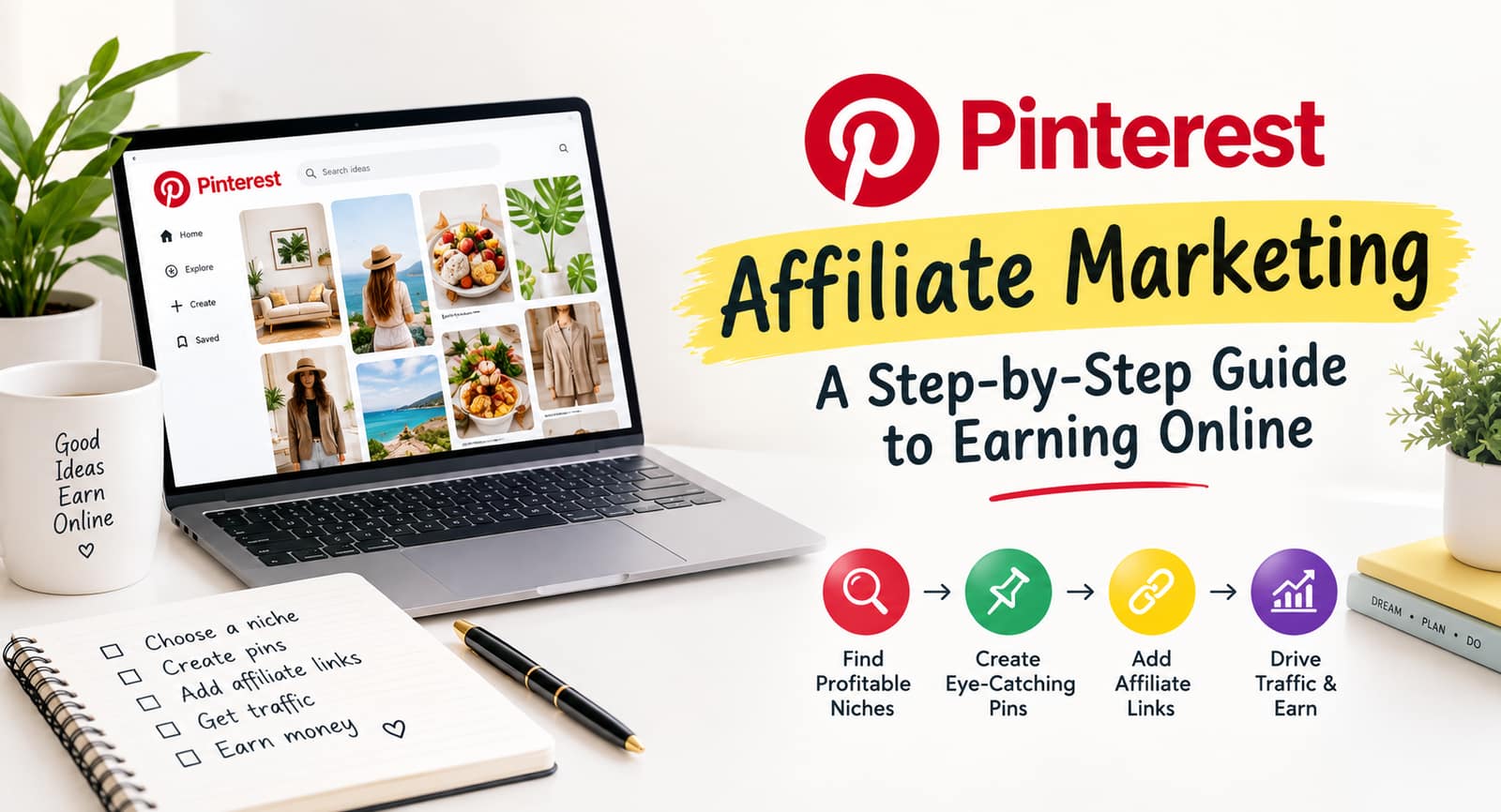
Learn how to start Pinterest affiliate marketing and build passive income. Discover affiliate programs, digital products, Pinterest SEO, pin creation, traffic strategies, and earning tips.
With affiliate marketing, you promote another company’s product or service using a special tracking link. When someone makes a qualifying purchase through your link, you can receive a commission.
Pinterest is not only a platform for finding ideas, recipes, fashion inspiration, and home décor. It can also be used to generate targeted traffic and earn money through affiliate marketing.
This guide explains how beginners can start Pinterest affiliate marketing step by step.
1. Choose a Profitable Niche
The first step is to select a niche. A niche is a specific topic that you will focus on consistently.
Popular Pinterest niches include:
- Home décor and organization
- Fashion and beauty
- Travel
- Cooking and recipes
- Fitness
- Gardening
- Crafts and DIY
- Wedding planning
- Productivity
- Technology and software
- Digital products
Choose a niche that has an audience, useful products, and enough topics for you to create content regularly.
Instead of choosing a very broad topic such as “home,” consider something more specific like small-space organization or budget home décor.
2. Understand Your Audience
Before promoting products, find out what your audience is searching for.
Think about:
- What problems do they have?
- What products might solve those problems?
- What questions are they asking?
- What type of ideas are they saving?
- Are they looking for inspiration, tutorials, comparisons, or products?
For example, people searching for “small bedroom storage ideas” may also be interested in storage boxes, shelves, organizers, and space-saving furniture.
3. Create a Pinterest Business Account
Create a Pinterest account focused on your chosen niche. A business account can provide useful tools and analytics for content creators and businesses.
Complete your profile with:
- A clear profile picture
- A relevant username
- A short niche-related bio
- Appropriate keywords
- Consistent branding
Your profile should make it obvious what type of content you provide.
4. Create Relevant Pinterest Boards
Create boards related to your niche.
For example, an organization account could have:
- Small Bedroom Organization
- Kitchen Storage Ideas
- Closet Organization
- Minimalist Home Ideas
- Home Office Organization
Use clear board names and descriptions. Keep your boards focused rather than creating many unrelated categories.
5. Find Affiliate Programs
The next step is to find companies or affiliate networks offering products related to your niche.
You can look for:
- Individual company affiliate programs
- Affiliate networks
- Online retailers
- Software companies
- Digital product platforms
- Travel services
- Educational platforms
Before joining an affiliate program, read its terms carefully.
Most importantly, check whether the program allows Pinterest traffic and direct affiliate links. Some programs may require you to send visitors to your own website or landing page first.
6. Choose Products Carefully
Do not choose products only because they offer high commissions.
Select products that:
- Match your niche
- Solve a genuine problem
- Are relevant to your audience
- Come from trustworthy companies
- Have useful information available
- Make sense for your content
Relevant products are usually easier to promote naturally because they fit the interests of your audience.
7. Be Transparent About Affiliate Links
If you may receive a commission from a purchase, provide an appropriate affiliate disclosure.
For example:
“This post contains affiliate links. If you purchase through one of these links, I may earn a commission at no additional cost to you.”
Follow the disclosure requirements that apply to your location, audience, platform, and affiliate program.
8. Research Pinterest Keywords
Pinterest works as a visual discovery and search platform. Users search for ideas, products, solutions, and inspiration.
Use Pinterest’s search bar to discover phrases related to your niche.
For example:
- Small bedroom ideas
- Budget home organization
- Best travel accessories
- Easy meal prep ideas
- Minimalist office setup
Use these ideas to create original content. Do not copy other creators’ titles, descriptions, images, or designs.
9. Create Attractive Pins
Pinterest is highly visual, so your pins should be clear and appealing.
You can use tools such as Canva to create original graphics.
A good pin can include:
- A strong headline
- A relevant image
- Simple typography
- Your branding
- A clear message
- A suitable call to action
For example:
10 Small Bedroom Storage Ideas
is more useful than a vague headline such as:
Amazing Ideas!
Make sure your pin accurately represents the content users will see after clicking.
10. Create Helpful Content
Avoid making every pin look like an advertisement.
Instead of:
“Buy This Storage Box!”
create content such as:
“9 Smart Storage Ideas for Small Bedrooms.”
You can then naturally recommend relevant products within the related content.
Useful content can include:
- Product guides
- Comparisons
- Tutorials
- Gift guides
- Checklists
- Product roundups
- “Best for” articles
- Problem-solving guides
The goal is to help the user first and promote the product second.
11. Use a Website or Landing Page
You may send Pinterest users directly to an affiliate offer when both Pinterest and the affiliate program allow it.
Another option is to use your own website or landing page:
Pinterest → Your Article → Product Recommendation → Affiliate Link
A website gives you more control over your content and allows you to provide detailed product information.
For example, an article could explain:
- Product features
- Benefits
- Potential limitations
- Who the product is suitable for
- Alternatives
- Buying considerations
12. Publish Consistently
Consistency is important.
You do not need to publish hundreds of pins immediately. Create a realistic schedule that you can maintain.
A simple strategy is:
Week 1: Set up your account, boards, niche, and content plan.
Week 2: Create original pins and publish useful content.
Week 3: Continue publishing and monitor performance.
Week 4: Identify successful topics and create more content around them.
Focus on quality and relevance rather than simply producing a large number of pins.
13. Track Your Results
Use Pinterest analytics and your affiliate dashboard to understand what is working.
Important metrics can include:
- Impressions
- Saves
- Pin clicks
- Outbound clicks
- Affiliate clicks
- Conversions
- Commission
- Conversion rate
Remember that impressions do not automatically mean earnings.
A pin with fewer impressions can sometimes generate more valuable traffic than a pin with thousands of impressions.
14. Improve Your Strategy
If a pin receives impressions but very few clicks, test different:
- Headlines
- Images
- Designs
- Topics
- Keywords
- Calls to action
If a particular topic generates clicks and conversions, create more useful content around that subject.
Affiliate marketing involves testing and improvement rather than relying on one perfect strategy.
15. Common Mistakes to Avoid
Beginners should avoid these common mistakes:
- Promoting unrelated products
- Copying other people’s content
- Using copyrighted images without permission
- Ignoring affiliate program rules
- Stuffing keywords unnaturally
- Making misleading product claims
- Focusing only on commission rates
- Expecting instant income
- Publishing content without tracking results
Always prioritize useful, accurate, and original content.
16. Can You Start Without a Website?
In some cases, yes. However, this depends on the rules of Pinterest and the individual affiliate program.
If direct affiliate links are permitted, you may be able to use them according to the applicable rules.
Alternatively, you can build a simple website or landing page and send Pinterest visitors there first.
A website can also help you build an email list, publish detailed reviews, and develop additional traffic sources.
17. Can You Start From Pakistan?
People in Pakistan can explore Pinterest affiliate marketing, but they should check each affiliate program’s eligibility and payment requirements before joining.
Pay attention to:
- Whether publishers from Pakistan are accepted
- Available payment methods
- Minimum payout requirements
- Currency conversion
- Tax obligations
- International payment restrictions
These conditions can change, so always verify the current information with the relevant affiliate program.
18. A Simple 30-Day Action Plan
Days 1–5
Choose your niche and research your audience.
Days 6–10
Find suitable affiliate programs and check their rules.
Days 11–15
Create your Pinterest business profile and relevant boards.
Days 16–20
Research keywords and prepare content ideas.
Days 21–25
Create original pins and publish useful content.
Days 26–30
Check analytics, identify promising topics, and improve your strategy.
How Much Can You Earn?
There is no fixed amount that everyone earns from Pinterest affiliate marketing.
Your results can depend on:
Traffic × Click-through Rate × Conversion Rate × Product Price × Commission
For example, if 5,000 people visit your content, 5% click an affiliate link, and some of those visitors make qualifying purchases, you may earn commissions according to the affiliate program’s terms.
This is only an example—not a guarantee of income.
Conclusion
Pinterest affiliate marketing can be a useful way to build an online income stream by connecting helpful content with relevant products.
The basic process is simple:
Choose a niche → Understand your audience → Join suitable affiliate programs → Research keywords → Create original pins → Publish consistently → Generate targeted traffic → Track results → Improve your strategy.
Success usually requires patience, testing, and consistent content creation. Instead of focusing only on making quick money, focus on helping users discover useful information and products that genuinely match their needs.
When you combine useful content, relevant affiliate products, Pinterest search optimization, and consistent publishing, Pinterest can become an important part of an affiliate marketing strategy.